News

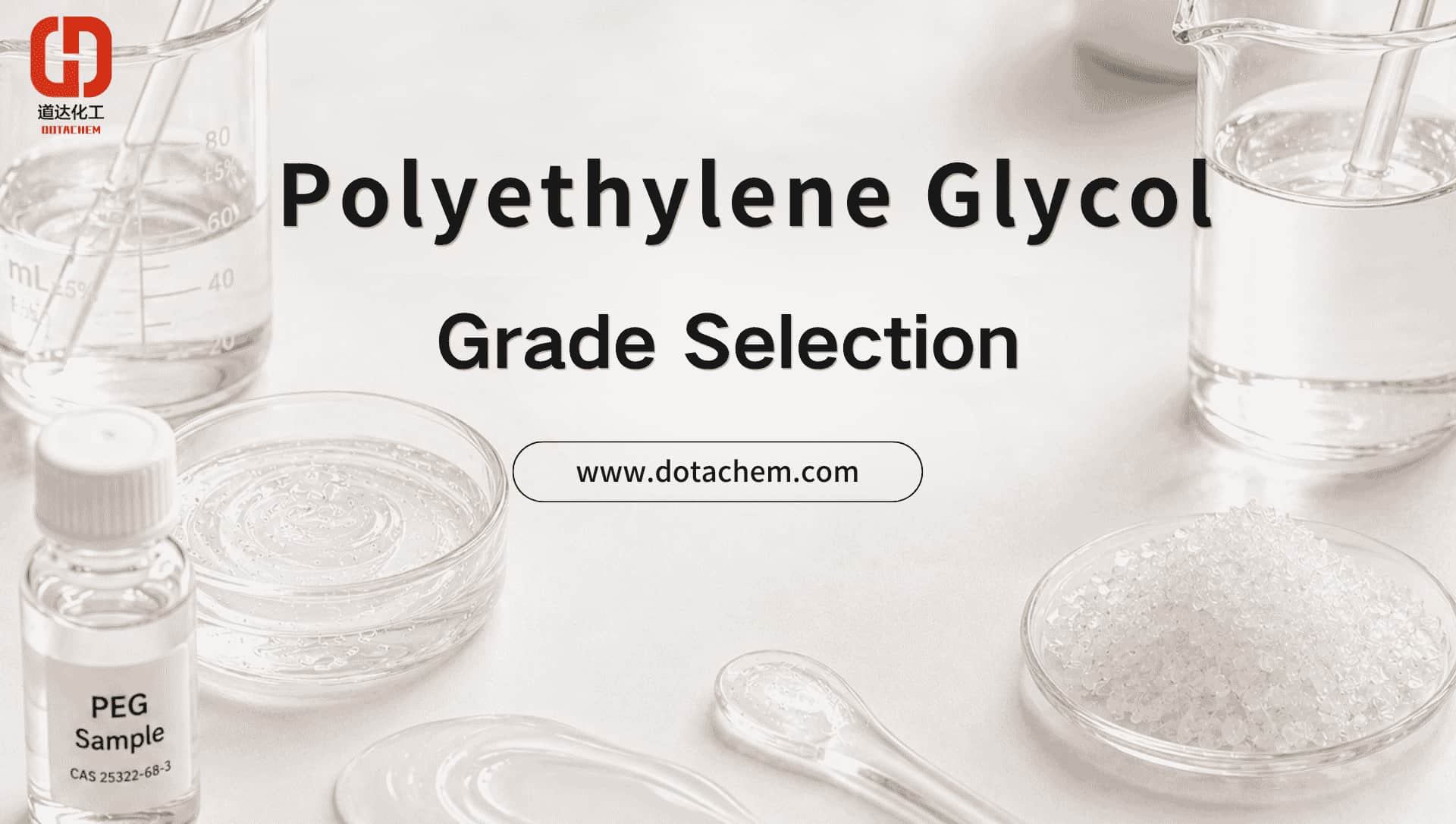
How to Choose the Right Polyethylene Glycol Grade for Different Applications

2026-05-08 0 Leave me a message


Many PEG inquiries start with one simple question: “What is your price for Polyethylene Glycoln (PEG)?”


As a China Polyethylene Glycol supplier with years of PEG supply experience, Dotachem often sees this situation: a buyer asks for PEG 400, PEG 6000 or “industrial PEG,” but the final application is not clear yet. After a few follow-up questions, the real need may turn out to be different. Some customers need a liquid PEG for a water-based formulation. Some need a solid grade for rubber, textile or plastic processing. Others need a PEG grade that can pass cosmetic, pharmaceutical or food-related review.


That is why Dotachem recommends choosing the PEG grade from the final application first, instead of starting only with the product name or the lowest price.


Check How the PEG Will Be Used


Polyethylene Glycol grades behave differently because their molecular weight is different. In daily purchasing, this affects several practical points: whether the product is liquid or solid, how easy it is to dissolve, how it performs during heating, and how it should be packed or stored.


For example, PEG 200, PEG 300 and PEG 400 are usually easier to handle in liquid systems. They are often considered when the buyer needs good water compatibility, easy mixing or solvent-like performance.


PEG 600 and PEG 800 may be selected when the formula needs a little more body or a different handling feel.


PEG 4000, PEG 6000 and higher molecular weight grades are more often used when a solid or wax-like material is required. These grades may need more attention during storage, feeding and production.


So before choosing a PEG grade, it helps to ask a very practical question: will this material be added into a liquid formula, melted into a process, used as a processing aid, or used as part of a finished product structure?


What Different Buyers Usually Care About


Different industries do not look at PEG in the same way. This is where many wrong selections happen.


A cosmetics buyer may care about odor, color and skin-feel impact. If PEG is used in a cream, cleanser, serum or transparent formula, small changes in appearance or odor can become noticeable in the final product.


A pharmaceutical-related buyer usually starts from the required standard and approval process. In this case, the grade name alone is not enough. The product needs to match the customer’s specification and review requirements before the order moves forward.


A textile or fiber processing customer may care more about solubility, softening effect, antistatic performance and how the material behaves during production.


A rubber or plastic manufacturer may pay attention to lubrication, dispersion and processing temperature. For these customers, the right PEG grade can help improve handling, but the wrong grade may create feeding or compatibility problems.


A coating, ink or pigment system buyer may focus on dispersibility, viscosity influence and storage stability.


For industrial fluid or metalworking applications, water compatibility, lubrication and processing conditions are usually more important than appearance alone.


This is why Dotachem usually asks about the application before recommending a PEG grade. The same product family can serve many industries, but the selection logic is not the same.


A Practical Way to Narrow Down the PEG Grade


If you are not sure where to start, the following method is usually more useful than comparing product names only.


First, confirm the product form you need. If your production line needs a liquid raw material, lower molecular weight PEG may be easier to handle. If your application needs a solid or wax-like material, higher molecular weight PEG may be more suitable.


Second, check the key specification items. For PEG procurement, buyers often need to review average molecular weight, water content, pH value, color, hydroxyl value and appearance. Some applications may also require tighter review.


Third, think about production conditions. Will the material be heated? Is it added directly into water? Does the factory have suitable storage or feeding equipment? These details can affect whether a grade is convenient to use.


Fourth, confirm the order scale. A sample order and a regular monthly order may need different packaging and supply planning.


Dotachem can help review these details before quotation, so buyers do not have to choose only by the grade name.


Common Mistakes Buyers Make When Choosing PEG


One common mistake is treating PEG grades as interchangeable. PEG 400 and PEG 6000 are both Polyethylene Glycol, but they are not used in the same way. They differ in form, viscosity, melting behavior and handling. Replacing one grade with another without testing may affect the formula or production process.


Another mistake is checking price before checking specification. A cheaper PEG grade is not always cheaper in the end if it causes retesting, formula adjustment or production delay.


Some buyers also ignore water content and pH value. These items may look small on a specification sheet, but they can matter in cosmetics, coatings, textile auxiliaries, pharmaceutical-related products and other formula-based applications.


Documentation is another point that is often confirmed too late. If COA, MSDS, TDS or other approval documents are needed, it is better to mention this during the inquiry stage, not after the shipment is being arranged.


Packaging can also create problems. Liquid PEG and solid PEG are not handled in the same way. Drums, bags, IBCs or other packaging should be chosen according to the product form, order quantity and factory unloading conditions.


What Information Should You Send to a PEG Supplier?


To get a faster and more accurate quotation, buyers can prepare a few details before contacting Dotachem:


  • Final application
  • Required PEG grade, if already known
  • Target specification or previous COA, if available
  • Required documents
  • Estimated quantity
  • Preferred packaging
  • Destination port or delivery country


With this information, Dotachem can check the suitable PEG option, available documents, packaging method and delivery plan more quickly.


How Dotachem Helps Buyers Avoid Wrong PEG Selection


For many buyers, the difficult part is not finding a PEG supplier. The real problem is choosing a grade that will work smoothly in their formula, production line and purchasing plan.


Dotachem can help buyers narrow down the PEG grade before sampling, especially when the customer is comparing liquid and solid grades, switching from one PEG model to another, or using PEG in a new formulation. Our team can review the application, target properties, handling conditions and order plan, then suggest a practical grade direction for further testing.


For customers in regular production, Dotachem can also help keep the purchase more stable by aligning sample approval with bulk supply, checking packaging suitability for factory handling, and coordinating shipment according to production schedules. This helps reduce repeated testing, wrong-grade purchases and last-minute changes before delivery.


If customers are sourcing several materials together, Dotachem can also help check related products and arrange combined supply when possible. Depending on the formulation or production process, buyers may also compare products such as Polypropylene Glycol (PPG), Triethylene Glycol, Diethylene Glycol, Propylene Glycol (PG), Phenoxyethanol, Nonylphenol Ethoxylate (NPE), Lauryl Alcohol Ethoxylate (AEO) and Polyvinyl Alcohol. Related product categories such as Surfactants, Polyether Polyol, Alcohols and Functional Additives may also be useful for customers who want to review more options from one supplier.


Final Note


Choosing Polyethylene Glycol is not just about finding a PEG number. The better question is whether that grade fits your formula, process, approval requirements and packaging conditions.


If you are looking for a China Polyethylene Glycol supplier and comparing PEG 200, PEG 400, PEG 600, PEG 4000, PEG 6000 or other Polyethylene Glycol grades, send Dotachem your application, quantity, required documents and destination port. 


Click quote require page, our team will help check a suitable grade and provide a quotation based on your actual purchasing needs.


Related News
Leave me a message
X
We use cookies to offer you a better browsing experience, analyze site traffic and personalize content. By using this site, you agree to our use of cookies. Privacy Policy
Reject Accept